
Content Summary: On locomotives, there is a silent “guardian”—the drying device. Its name is simple and straightforward: it’s used to absorb water. So, why do we need to remove this moisture from the compressed air? What problems does it cause in our system?
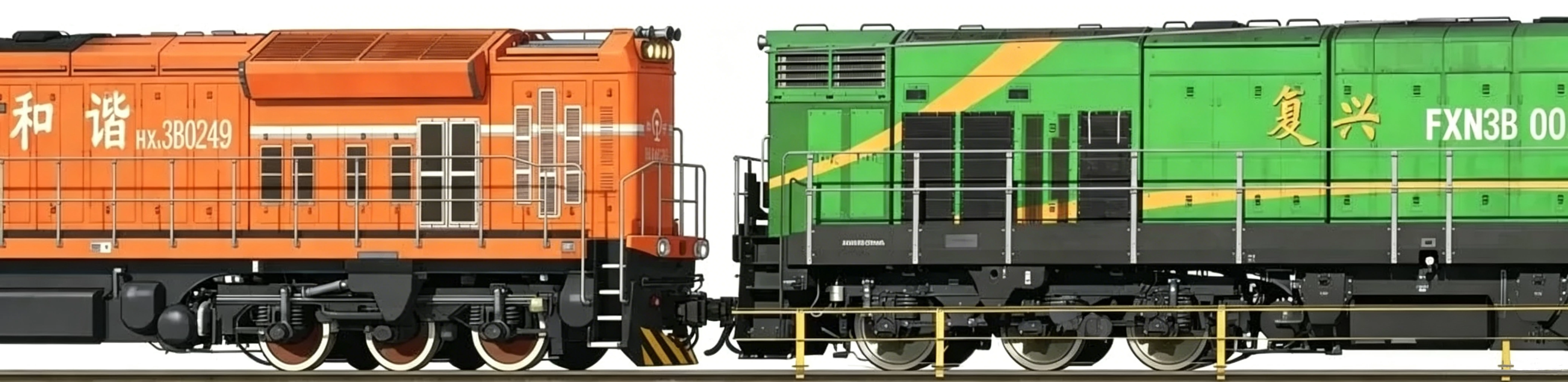
Risk Assessment
1. Why can’t compressed air hold water?
There are two main “crimes”:
First, it causes corrosion.
Water corrodes metal components. Rust not only weakens the metal’s strength, but the resulting rust residue can also clog passages, leading to more serious malfunctions.
Second, and most troublesome—it causes freezing damage.
Freezing damage mainly targets rubber components in the pipelines. Once the temperature drops below freezing, water freezes, expands in volume, and acts like sharp knives, potentially cutting and perforating the rubber seals, causing them to completely lose their sealing function. This is the real “invisible killer.”
Therefore, the core function of the drying device is to absorb water vapor in compressed air, preventing corrosion and freezing damage at the source.
2. Why can’t compressed air hold oil?
The compressed air after the air compressor has been working contains lubricating oil mist. Oil is a major culprit in clogging pipelines. The strong combination of oil, water, and dust can directly lead to clogging of small valve orifices (such as the “tear hole” of the 120 valve in vehicles, which is the pressure stabilization orifice). Therefore, there is an oil filter after the air circuit of the locomotive dryer to filter out the lubricating oil components in the compressed air.
Working Principle
The core of the drying device uses something similar to food packaging desiccants—except its dosage is larger, and its form may be granular molecular sieves, silica gel, or calcium chloride, etc.
When humid compressed air flows through these desiccants, water vapor is adsorbed, resulting in dry air. However, the desiccant’s “appetite” is limited. As it absorbs more and more moisture, it gradually becomes saturated and loses its drying capacity. The traditional method is to shut down the machine and replace the saturated desiccant. The system used on locomotives, however, operates on an adsorption-regeneration principle.
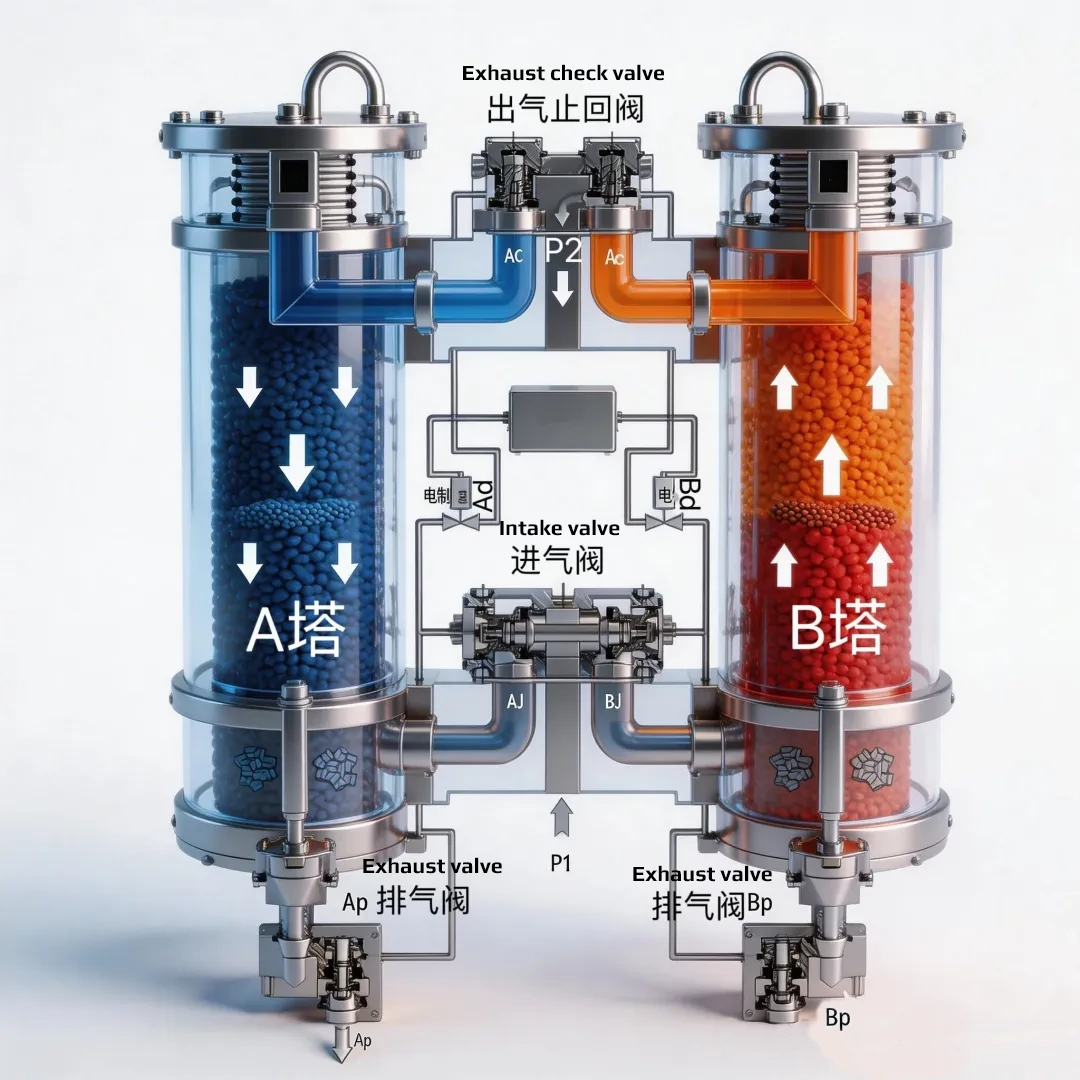
Locomotive air dryers are classified into three types: single-tower air dryers; double-tower air dryers; and membrane dryers.
A single-tower (also called a single-cylinder) air dryer is a dryer without heat regeneration. Its characteristic is that the adsorption and regeneration of the adsorbent occur within the same drying cylinder.
A membrane dryer system includes a membrane dryer and a pre-filter (three-stage filter) to remove water and oil.
A double-tower (also called a double-cylinder) air dryer operates on the same dehumidification principle as the single-tower type, except it has two drying towers that dehumidify alternately, continuously outputting dry compressed air.
Compared to DC-drive locomotives, AC-drive locomotives use air compressors with smaller displacements. The intervals between compressor downtime are insufficient to meet the regeneration time required for a single-tower dryer; therefore, a double-tower air dryer is used.
Troubleshooting
The drying tower is in adsorption mode, and the exhaust valve is leaking air continuously.
This phenomenon indicates an exhaust valve malfunction:
1) The valve gasket is damaged or foreign objects are blocking the valve opening;
2) The nut on the exhaust valve screw is loose.
Remove the exhaust valve for inspection:
1) Replace the damaged valve gasket or remove foreign objects from the valve opening. If the valve opening is damaged, replace the valve seat;
2) Retighten the nut. If the nut is damaged, replace it.